


There is one wall in the nursery that never sits right, and it is almost always the one above the crib.
A single small print, hung dead center, floating in all that paint like a stamp on an envelope three sizes too big. The crib is wide, the wall is wide, the art is not.
So your eye keeps landing on the gap around the frame instead of the picture, and the wall reads unfinished no matter how much you like the print.
So stop hunting for one print big enough to carry it. The fix is a nursery gallery wall, built with one formula you can reuse on every wall in the house after this one. The rest of the room is already fine; it is only ever this.
Why the wall over the crib reads wrong
A wall above a crib goes wrong for one of three reasons, usually two at once. The art is too small for the wall it sits on. It hangs too high, drifting toward the ceiling because it got measured against a standing adult instead of the room it lives in.
Or there is one lonely piece where the wall is asking for a block. Scale, height, emptiness. A gallery of three fixes all three at once, which beats hunting for a single print big enough to carry the wall alone.
The over-crib gallery wall, in four numbers
This is the part worth saving. It holds whether your theme is woodland, safari, or nothing at all, and it works over a dresser or an open wall as well as over a crib.
Make it a block, not a dot
Over a wide crib, a set of three is the most forgiving choice there is. Odd numbers settle easier than even ones, and three pieces read as one confident block instead of one lonely dot. From the very first measurement, treat the whole set as a single rectangle, not three separate decisions.
Two-thirds of the crib, or nearly all of it
Measure your crib's width first. A standard one runs about 54 inches, and you have two good ways to fill it. For a calmer, lighter look, three 12-by-18 prints with a couple of inches between them make a block about 40 inches wide, right around two-thirds of the crib.
For a fuller wall that spans almost the whole crib, size up to three 16-by-24 prints: three 16-inch pieces plus the gaps run about 52 inches, close to the full 54. Both read finished; the bigger set just carries more of the wall.
The one thing to avoid either way is going small. The number-one regret parents tell me about is art that ended up too little for the wall, and almost nobody overshoots.
Center it at 48 inches, not 57
Here is the number the internet gets wrong for kids' rooms. Every hang-height guide online says 57 inches, a rule written for a grown-up standing in a grown-up's room. A nursery is neither.
The person who actually looks at nursery art is you, sitting in the glider at 2am, and your sightline down there is closer to 48 than to 60.
So center the whole block at 48 inches from the floor. That 48 marks the middle of the block, not the top edge, not the bottom, and it holds whichever size you chose. The 12-by-18 set lands its bottom edge around 39 inches, comfortably clear of a standard crib rail.
The taller 16-by-24 set hangs from the same 48 center, but because each piece is 24 inches tall its bottom edge sits nearer 36 inches, closer to the rail.
That fuller set is happiest over a crib with a lower rail, or with the crib pulled a few inches off the wall so there is daylight underneath. Same center, one thing to check.
The one thing that ever changes the number: who is looking. The day the crib becomes a bed and your child studies the art standing up, bring the center down toward 40 inches, their standing eye level, never up. Same rule, one moving part: hang it where the person looking at it can actually see it.
Center the rectangle, hang from the middle out
Treat the three as one block again. Center that block on the crib, not on the wall, because the two are rarely the same line. Keep the gaps even, about two inches, and start with the middle piece, then work outward.
Cut one paper rectangle the size of the whole block, tape it up at 48, and step back before a single nail goes in.
One rule I never bend: keep the space directly over where the baby sleeps calm and clear, and hang it the way a careful parent would. Over the crib, favor a shatter-resistant plexiglass cover instead of heavy glass, so there is no glass to break above the sleep zone.
Keep the pieces light, and anchor into a stud or a wall anchor rated for the weight, never straight into bare drywall. Keep the bottom of the frames well above the rail, higher than a standing toddler can reach. Skip anything with cords, strings, or small parts that could work loose.
And if you want the freedom to hang whatever you like without weighing any of this, pull the crib a few inches out from the wall; that one move takes the whole question off the table.
This is sensible practice, the way a careful parent would do it. It is not a safety guarantee, and nobody knows your room better than you do.
The same wall, with the formula on it
Here is that lonely wall again, only now the print is a block of three. It fills about two-thirds of the crib, its center sits at 48 inches where you look from the glider, and the bottom edge clears the rail with clean daylight to spare.
Nothing changed but this one wall, and suddenly it looks finished on purpose.

The 30-minute version and the do-it-right version
The fast, forgiving pass
Buy a set of three that already coordinates, so you skip the color matching. Hang them in a straight row, the most forgiving layout there is. Cut one paper rectangle the size of the whole block, tape it up with its center at 48, step back, adjust, then hang.
Even gaps, centered on the crib, done before the next nap.
The careful, permanent pass
Same formula, more precision. Cut a paper template for each frame, not just the block. Find your studs, or use anchors rated for the weight. Mark every nail before you drill anything. Set the gaps with a ruler instead of an eye.
And plan one step ahead: note where the center drops to when the crib becomes a bed, so future-you slides the art down a few inches instead of buying it twice.
A set built to hang as one block
When the formula calls for a block of three, a set designed to live together does the coordinating for you, which is most of the work a gallery wall actually asks.
This one is the calm, gender-neutral kind that sits well over a crib: a trio in soft, warm tones meant to read as a row.
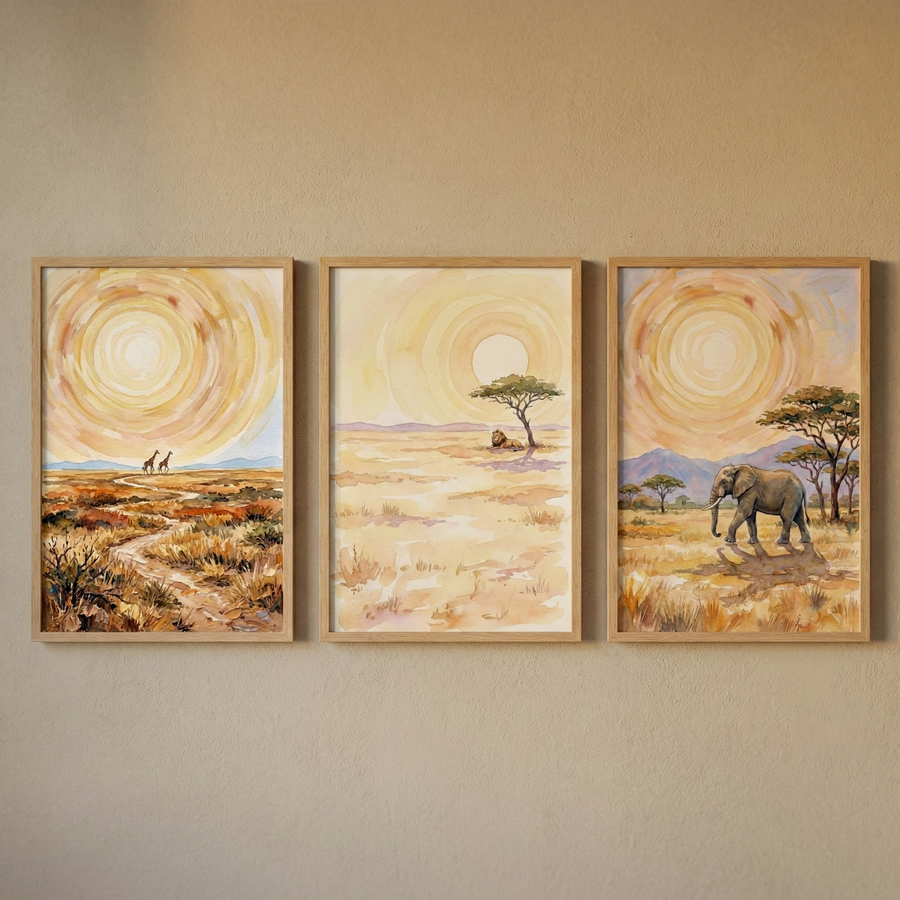
Browsing for the block? Start with the gallery wall sets, then the wider nursery wall art and the calmer neutral nursery wall art that suits an over-crib wall.
The three things in the fix
The set that does the fixing, plus the crib and the wall color in the room. Each opens in a new tab.
 Savanna Nursery Wall Art Set of 3
Teepee Joy
Savanna Nursery Wall Art Set of 3
Teepee Joy
 Hudson 3-in-1 Convertible Crib, White
Babyletto
Hudson 3-in-1 Convertible Crib, White
Babyletto
The prints ship with a plexiglass cover, which is the over-crib safety call.
Get the next one-wall fix in your inbox
I take one wall that reads wrong and hand over the formula that fixes it, whenever a good one lands. Leave your email and the next fix comes straight to you, numbers and all. No noise, unsubscribe whenever.
Hmm, that didn't go through. Mind trying again?
You're in. The next one-wall fix will land in your inbox.
Nursery gallery wall: quick answers
How many pieces should a nursery gallery wall have?
Over a wide crib, a set of three is the most forgiving choice. Odd numbers settle more easily than even ones, and three pieces read as one confident block rather than one small piece lost on a big wall.
Treat the whole set as a single rectangle: three 12-by-18 prints fill about two-thirds of a standard 54-inch crib, while three 16-by-24 prints span nearly the whole crib. Whichever you pick, keep it big; too-small art is the regret parents mention most.
How high do you hang a gallery wall over a crib?
Center the whole block at 48 inches, not the usual 57. That rule was written for an adult in a grown-up's room; in a nursery the person looking at the art is you, seated in the glider, so your sightline sits closer to 48.
With 18-inch prints, a 48-inch center puts the bottom edge near 39 inches, above a standard rail. When the crib becomes a bed and your child looks standing, bring the center down toward 40.
Is it safe to hang art above a crib?
Hang it the way a careful parent would: favor a shatter-resistant plexiglass cover over heavy glass, anchor into a stud or a rated wall anchor rather than bare drywall, keep the frames well above the rail and out of a toddler's reach, and skip cords, strings, or loose parts.
If you would rather not weigh it, pull the crib off the wall, or hang the set beside it. Sensible practice, not a guarantee. You know your room best.
The wall above the crib doesn't need a bigger print. It needs a block of three, hung at 48 inches, where you actually sit.